
A Proposal for Dialectics
By Bruno Jacopé-Fouchereau // Email: bruno.fou32@gmail.com
This text could not have come to fruition without the help of my wife, Florence Jacopé-Fouchereau (Psychologist, psychodramatist…). It is largely the fruit of our exchanges and crossed perspectives that brought our practices into dialogue.
Sacred Hermeneutics and the Clinic of the Unconscious
Elements for an Epistemology of Convergences Between the Mystical Practices of Kabbalah and Christian Mysticism with Certain Psychotherapies. Analogies, Transpositions, and Bases of Reflection for Testing Therapeutic Models.
The history of modern psychotherapy is underpinned by a permanent tension between the desire for emancipation from religious dogmas and the unacknowledged reuse of their foundational structures. In seeking to establish a rational clinical practice, psychiatry and psychoanalysis erected themselves as secular disciplines. However, the historical and conceptual reassessment of the origins of the psychodynamic approach reveals a deep « debt » toward contemplative traditions, chief among which is Kabbalah (קַבָּלָה: « reception » or « tradition ») [1]. Several researchers have demonstrated that theoretical models—notably those of Sigmund Freud [2] and Carl Gustav Jung [3]—transpose mystical representations of the psyche and language into a secularized form. Jung himself acknowledged that Jewish theosophy had anticipated the architecture of his analytical psychology, particularly the concepts of the archetype, the integration of the shadow [4] (that which is unexplored), and the dynamics of individuation [5].
In the contemporary field of clinical psychology, anthropology, and philosophy, the work of psychologist Sanford Drob [6] (see boxed text at the end of the article) has formalized the « New Kabbalah » [7]. Drob demonstrates that the symbols of Jewish mysticism do not merely constitute objects of historical study, but provide an hermeneutic matrix capable of illuminating and structuring various psychotherapeutic practices. Far from being mere esoteric speculations, Kabbalistic methods propose a semiotics of the unconscious [8], an ontology of suffering, and devices for transformation that prefigured Lacanian psychoanalysis, psychogenealogy, music therapy, as well as cognitive-behavioral therapies, especially those focused on mindfulness [9].
The proposal of this text aims at a preliminary comparative analysis between traditional Kabbalistic practices and therapeutic modalities used in medical institutions and private practice settings. The goal is to identify several underlying psychological mechanisms of these techniques in order to open up perspectives for empirical research. The ultimate project is to arrive at multidisciplinary experimental workshops that could emerge through conferences and study sessions fueled by various resources (to be defined). It would also involve designing and modeling the use of Biblical Hebrew in therapeutic processes as a power for activating archetypes [10] and imaginaries within the Judeo-Christian cultural sphere. Knowing that learning the rudiments of Hebrew to practice can be considered a therapy in itself—at least if Biblical Hebrew is taught through a pedagogy composed of Kabbalistic mystical techniques: gesturalizations, breaths, vocalizations, and chants. All of these techniques fall within the nomenclature of the Anthropology of Gesture invented by the anthropologist and Jesuit Father Marcel Jousse [11]. On this subject, I invite the reader to read my article: « Le chant des voyelles hébraïques… » [12] (https://lun-deux.fr/le-chant-des-voyelles-hebraiques/).
1. Textual Deconstruction and Metaphorization: Gematria, Tzeruf… The Unconscious Structured Like a Language
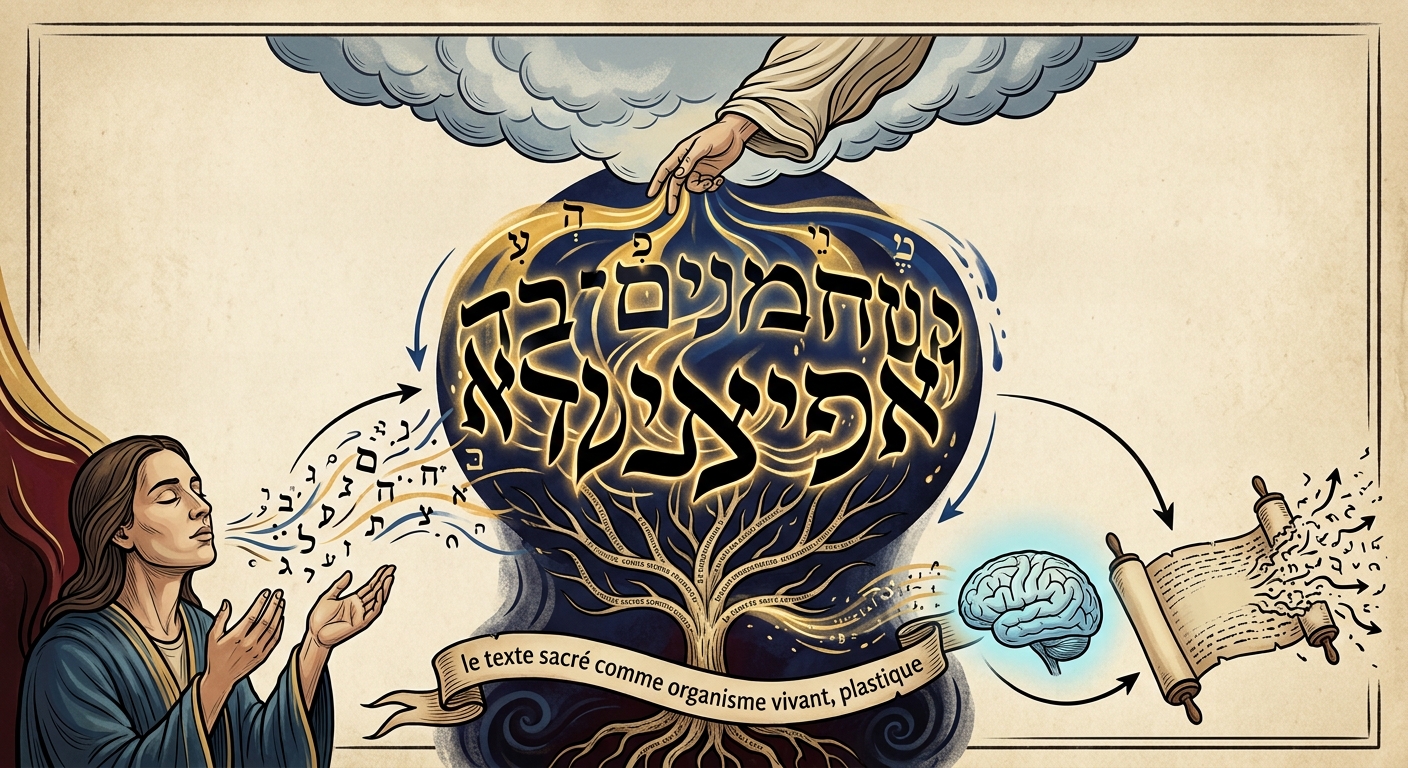
The Kabbalistic tradition apprehends the universe as an intrinsically linguistic reality whose raw material consists of the 22 consonant letters of the Hebrew alphabet [13], which themselves form a creative symbolic field animated by vowels. The sacred text is therefore not considered a frozen narrative, but a living, plastic organism endowed with an infinity of meanings in coherence with what is humanly incomprehensible: « divine intelligence. » To access these hidden dimensions and become receptacles for them for a prophetic purpose, Kabbalists developed exegetical and ecstatic techniques of great semiotic sophistication, which find a powerful echo in the theory of the unconscious and post-structuralism [14].
Mystical Semiotics and Cognitive De-automatization
Kabbalistic hermeneutics relies on four main methods of conceptualizing letters/consonants (22), their vocalization through the 5 main vowels, and texts:
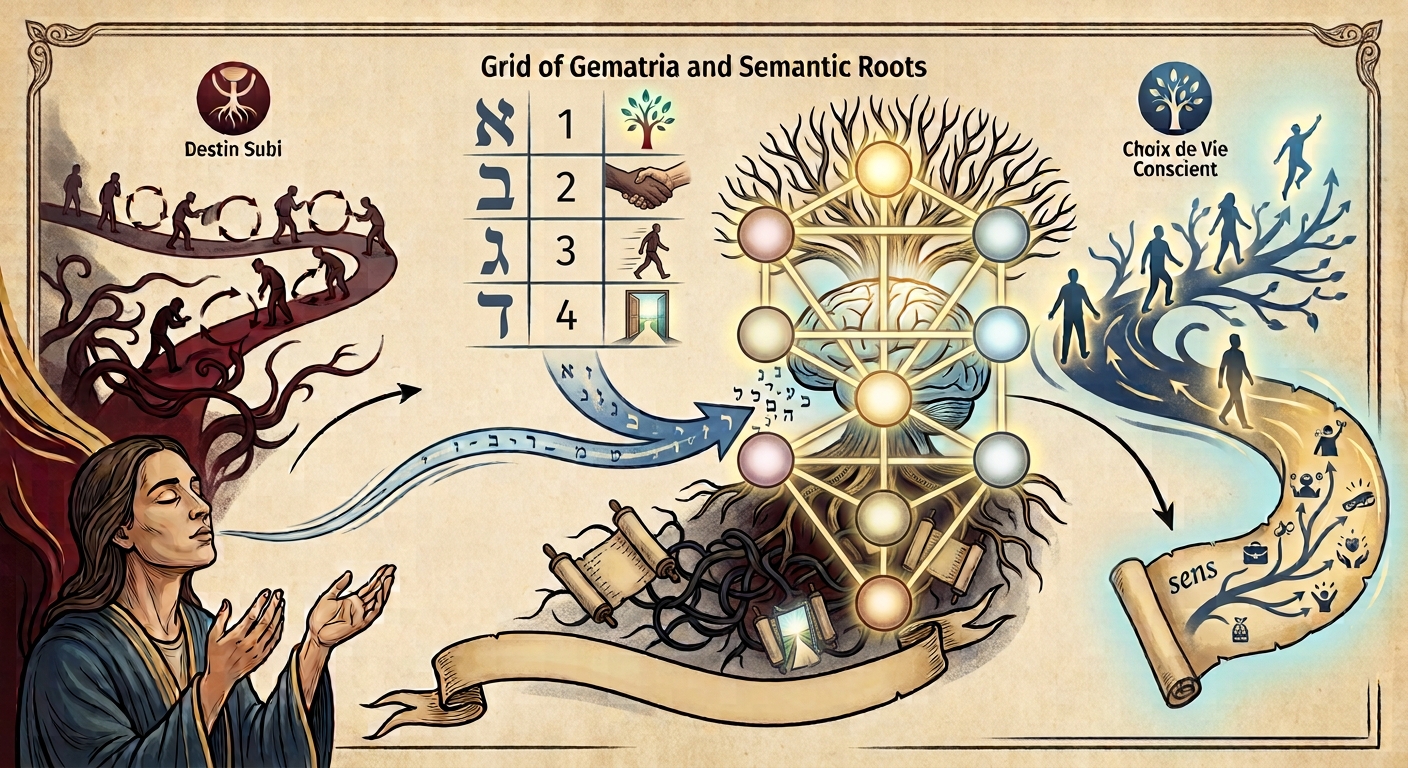
- Gematria (גְמַטְרִיָּה, « numerical calculation ») associates a numerical value with each letter, establishing semantic bridges between terms of the same numerical sum to bring out hidden equivalences [15].
- Tzeruf (צֵרוּף, « combination » or « permutation ») consists in permuting the sequence of letters of a word and its vowels in order to dismantle its formal shell and liberate new signifiers [16].
- Notarikon (נוֹטָרִיקוֹן, « acronym » / « scribe ») extracts the initial or final letters of a series of words to form a synthetic term, or conversely, expands a single word into a complex sentence [17] (other practices exist).
- Root Analysis (mainly triliteral) from which all words in Biblical Hebrew are constructed [18].
From a clinical point of view, these practices seem able to act as vectors of semantic de-automatization [19]. The neurotic subject is frequently characterized by confinement within a rigid narrative, a network of petrified representations that feed rumination and symptoms. Applying the Kabbalistic techniques mentioned above forces thought to detach from manifest meaning in order to explore the fluidity of signifiers. This textual decomposition seems capable of freeing speech from conscious automatisms and allowing the emergence of free associations—a process fundamental to the analytical phase of a treatment [20].
The Instance of the Letter in Lacan and Freudian Metaphorization
This conception of the universe governed by the laws of language aligns with Jacques Lacan’s thesis that the unconscious is structured like a language [21]. In his seminar on The Instance of the Letter in the Unconscious, Lacan demonstrates that the formations of the unconscious (dreams, slips of the tongue, jokes, symptoms) operate according to two fundamental semiotic shifts: metaphor, which involves substituting one signifier for another, and metonymy, which relies on connecting signifier to signifier [22].
This process of metaphorization is a direct continuation of the mechanisms conceptualized by S. Freud regarding dream-work, namely condensation (Verdichtung) and displacement (Verschiebung) [23].
Notarikon operates as a linguistic condensation where multiple terms are reduced to a single structure, whereas Tzeruf (צֵרוּף, « combination » or « permutation ») applies a displacement along the alphabetical chain by rotating consonants and vowels within the same word or sentence. Notarikon (acronyms) allows the deep meaning of a sentence to emerge. The study of roots deploys the semiology of a word… If used in psychotherapy, these techniques could increase the patient’s semantic flexibility to guide them toward restructuring the metaphor of their symptom and producing new existential meanings [24].
Derridean Deconstruction and Lurianic Tzimtzum: Another Field of Reflection on the Therapeutic Forces of Kabbalah
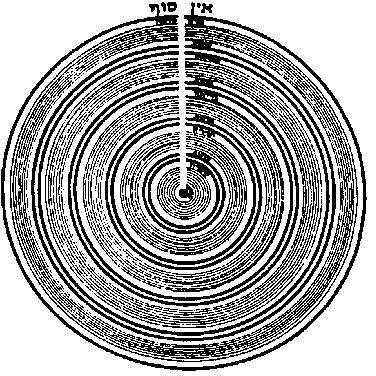
On a philosophical level, Kabbalistic techniques have been put at the service of deconstructivism theorized by Jacques Derrida [25]. Derrida challenges the myth of an ultimate meaning or a frozen original presence, asserting that the text produces an infinite play of references and differences. Derridean thought resonates closely with the Kabbalistic concept of Tzimtzum (צִמְצוּם, « withdrawal » or « contraction »), formulated by Isaac Luria in the 16th century [26]. According to this cosmogonic myth, the divine Absolute, the Ein Sof (אֵין סוֹף, « without end » or « the Infinite »), withdrew into itself to create a primordial void—a necessary space for the emergence of alterity and the temporal universe [27].
Transposing this same dynamic of Tzimtzum to the clinic, Sanford Drob emphasizes that the Ein Sof acts within the therapeutic framework as an infinite container [28]. The therapist, by practicing a form of Tzimtzum—that is, by suppressing their desire for mastery, dogmatic interpretation, or closure of meaning—opens an empty space within which the patient can unfold the plurality of their personal narrative. Psychotherapy then becomes an indefinitely open hermeneutic process where no interpretation definitively seals the subject’s truth [29].

2. Nominal Ontology and Psychogenealogy: Kabbalistic Analysis of the Subject’s Name and the Transgenerational Clinic
Within the Kabbalistic system, an individual’s given name(s) and proper names (Shem / שֵׁם, « name », a Hebrew word/root also evoking listening) [30] are by no means arbitrary conventions or mere social labels. Once Hebraized for individuals with non-Jewish names, they constitute the vibrational structure, ontological imprint, and spiritual program of the individual; paradoxically conditioning their individuation. The Sefer Yetzirah (סֵפֶר יְצִירָה, « Book of Formation ») teaches that Divine Names and the names of creatures are the channels through which creative energy incarnates into the material world [31]. Analyzing the letters composing a person’s name, the resulting gematric values, and the breath of the vowels animating it thus offers an interpretive grid of the tensions, inheritances, and potentials running through the subject’s existence. It is important to note that Kabbalistic analysis of a person’s name is a traditional rabbinic practice aimed at healing a suffering person and/or helping them align with the « divine plan » [32]…
Psychogenealogy and the Unconscious Mandate of First and Last Names
This conception of a regenerative power—a divine breath of coherence and harmony lodged in the name of every living being—finds its contemporary counterpart in psychogenealogy, particularly developed by Anne Ancelin Schützenberger [33]. Through the elaboration of the genosociogram—a commented family tree integrating life events, unsaid traumas, illnesses, and anniversary dates—the transgenerational clinic demonstrates that individuals are often caught in networks of invisible family loyalty [34]. At the heart of this device lies the meticulous study of the first name. A parent’s choice of a first name is never accidental; it materializes the « project-meaning » (projet-sens), namely the totality of unconscious desires, unresolved griefs, expectations, or doubts transmitted down the lineage… Psychogenealogy thus highlights the presence of cryptograms within first names, whose sounds or syllables code underlying family dramas [35].
Possible Methodological Convergences: From Kabbalistic Decoding to Genealogical Liberation
Integrating the Kabbalistic interpretive grid into transgenerational clinical practice could allow crossing the symbolic decoding of letters with the investigation of family secrets, unleashing imaginative and conceptual forces. By decomposing a patient’s « Hebraized » name and first name using semantic roots or numerical equivalences, a therapist trained in Kabbalistic techniques could help the subject identify the unconscious charge they carry unbeknownst to them. Bringing these networks of meaning to light could also enable the patient to break free from neurotic repetitions and transform a suffered destiny into a conscious life choice.
|
Analytical Dimension |
Kabbalistic Nominal Hermeneutics |
Psychogenealogy (Ancelin Schützenberger) |
|---|---|---|
|
Status of First & Last Name |
Ontological matrix and vibrational structure of being (Shem / שֵׁם, « name »/ »listening »). |
Receptacle of the « project-meaning » and unconscious mandate. |
|
Methodological Tools |
Gematria (גְמַטְרִיָּה, « calculation »), Tzeruf (צֵרוּף, « permutation »), Hebrew root decomposition. |
Genosociogram, syllable analysis, study of homonymies. |
|
Source of Conflict |
Disconnection between the incarnated name and the spiritual archetype. |
Invisible family loyalty, unelaborated traumas. |
|
Therapeutic Objective |
Tikkun (תִּקּוּן, « repair/rectification ») of the name, spiritual realignment. Chanting Divine Names (Shem Hamephorash techniques, etc.). |
Deactivation of repetitions, re-appropriation of destiny. |
3. Sound Dimension, Music Therapy, and Cognitive Restructuring: The Niggun and the Quest for Nekudat Ha-Tov
The development of the Hasidic movement in the 18th century brought about a democratization of Kabbalah by placing affect, music, and emotional enthusiasm at the center of spiritual life. Two Hasidic practices of this nature offer particularly fertile analogies with music therapy and the third wave of cognitive-behavioral therapies: the singing of the Niggun (נִגּוּן, « tune » or « melody ») and the search for the Nekudat Ha-Tov (נְקֻדַּת הַטּוֹב, « the point of goodness » or « the point of benevolence »).
The Niggun as a Music-Therapeutic Modality
The Niggun is a form of wordless mystical chant based on repetitive, rhythmic vocalized syllables (vocalized letters). In its most developed form, this practice incorporates the verbalization of « Divine Names » (Shem Hamephorash) and concludes Kabbalistic analytical journeys through Gematria, Tzeruf, etc., of meditated and verbalized elements, as well as in the context of the Kabbalistic study of an individual’s name. Unlike textual liturgies, the Niggun aims to bypass intellectual constructions to directly address the deep layers of the psyche. In Kabbalah, alternating between intellectuality and contemplation is fundamental; these are the two legs by which the mystic advances toward their encounter with God. Technically, it involves reaching the point of intellectual saturation to enter into contemplation of that which cannot be conceived, and vice versa. Generally, Kabbalistic mystics report discovering an amplified intellectual capacity that enables them to conceive divine realities they could not previously grasp or express… They then push these new capacities to saturation, entering contemplation once more… A whole series of techniques exists for applying oneself to this discipline.
The classical structure of a Niggun follows a precise dramatic arc and dynamic: it begins with a slow, nostalgic melody expressing distress, melancholy, or a sense of exile, then progressively accelerates until reaching a dynamic rhythm fostering joy and catharsis.
In music therapy and psychotraumatology research, the Niggun could constitute a highly effective somatic intervention tool. States of psychic suffering and complex traumas are largely encoded in subcortical brain structures and the autonomic nervous system, rendering them partially inaccessible to talk therapy alone. Non-verbal vocalization, combined with rhythmic repetition, produces a trance-like effect and helps to:
- Regulate the stress axis by stimulating the parasympathetic nervous system and the vagus nerve.
- Bypass neurotic defenses and verbal inhibitions to allow direct expression of blocked affects.
- Create relational synchronization and affective attunement within a therapeutic group—especially if what is sung (Shem Hamephorash / divine name / name of power) stems from a Kabbalistic process as described.
Nekudat Ha-Tov: Cognitive Reframing and Alchemy of the Shadow
In terms of motivational psychology and cognitive restructuring, an analogy can be drawn with what Rabbi Nachman of Breslov (1772–1810) formalized through the Kabbalistic concept of Nekudat Ha-Tov (נְקֻדַּת הַטּוֹב, « the point of goodness » or « the point of benevolence »). In his teachings in Likutey Moharan, Rabbi Nachman posits that no individual—regardless of the extent of their moral degradation, sadness, or guilt—is entirely devoid of good, nor lacking resources for Teshuvah (תשובה = return to God / repentance / response). This idea joins what Internal Family Systems (IFS) calls the Self, an inalterable core resource that everyone possesses.
The duty of the spiritual guide, the Tzaddik (צַדִּיק, « righteous one » or « spiritual guide »), consists in tracking down the slightest spark of goodness in the subject, isolating it from the mass of negative thoughts, and judging it favorably in order to rebuild their self-esteem right where God awaits them in benevolence.
This approach strikingly prefigures Carl Rogers’ principle of unconditional positive regard in person-centered therapy, as well as cognitive reframing techniques in CBT (especially compassion-focused therapy) and the presence of the Self in IFS. Finding the Nekudat Ha-Tov amounts to executing a major cognitive reframing, altering negative evaluation biases and patient self-deprecation.
According to Sanford Drob, this practice is rooted in Lurianic cosmology. Drawing parallels with Kabbalistic elements, he considers that evil and mental illness are not autonomous ontological realities, but shells—the Kelipot (קְלִפּוֹת, « husks » or « shells »)—that imprison parcels of divine light in the form of captive sparks, the Nitzotzot (נִיצוֹצוֹת, « sparks »). Therapeutic work does not consist in forcefully destroying the symptom, but in splitting the symptomatic shell to free the spark of life and value contained within.
4. Meditative Practices and Visualization: Kavanah, Hitbodedut, and Restoration of the Self
The Jewish mystical tradition developed a phenomenology of consciousness accompanied by attentional and imaginative techniques that intersect with analytical psychology and third-wave therapies.
Kavanah: Mindful Presence and Attentional Regulation
Kavanah (כַּוָּנָה, « intention » or « direction of the heart ») denotes a state of total presence, concentration, and devotion in which one’s most intimate and precious self is summoned—an attitude of being that must accompany every action, prayer, or ritual. Kavanah stands in opposition to Mitzvat Anashim Melumada (מִצְוַת אֲנָשִׁים מְלֻמָּדָה, social « commandments » learned and performed routinely), i.e., mechanical execution devoid of awareness in daily and sacred acts (two domains in constant interaction). This corresponds to what Jacob Levy Moreno, who initiated psychodrama, calls « cultural conserves »—rigid, automatic roles characterized by a lack of spontaneity.
In contemporary clinical practice, Kavanah presents a direct analogy with Mindfulness. It constitutes attentional retraining that deactivates the brain’s Default Mode Network (DMN), often associated with anxious and depressive ruminations. Practicing Kavanah reintroduces conscious intentionality into the present moment, strengthening the subject’s affective self-regulation capabilities. It also echoes psychodrama in requiring an active and global presence hic et nunc (here and now).
Hitbodedut: Self-Verbalization, Catharsis, and Inner Dialogue
Hitbodedut (הִתְבּוֹדְדוּת, « seclusion » or « self-solitude ») is a meditative method advocated by Hasidism and inherited from medieval Kabbalists. It consists in retreating to an isolated space—preferably in nature—to converse in a completely spontaneous, unpolluted manner with the Divine, free from distractions and temptations. The practitioner is encouraged to address God in their mother tongue, unreservedly exteriorizing desires, fears, anger, ambitions, and doubts… then assuming a posture of contemplation, reception, and listening, and finally interpreting analogically and imaginatively what manifests (particularly through sacred texts), thus initiating a fertile dialogue with God.
From psychodynamic and emotional therapy perspectives, Hitbodedut can serve as a vehicle for free association and cathartic discharge. As such, it offers a safe space for emotional exposure where raw affects—normally suppressed by social conventions or shame—are verbalized. The Kabbalistic concept of Hitbodedut resembles the bataka in psychodrama, a device allowing the safe expression of repressed emotions like anger. One can also recognize in these Kabbalistic practices the « empty chair » technique or expressive therapeutic writing protocols.
Yichudim and Archetypal Integration: Active Imagination in Jung
Meditative Kabbalists, especially from the schools of Abraham Abulafia and Isaac Luria, practiced Yichudim (יִחוּדִים, « unifications »). The ultimate goal of Yichudim is to repair the world by repairing oneself—pertaining to Tikkun Olam (תיקון עולם, « repair of the world »), widely discussed in Jewish literature. Yichudim exercises consist of complex mental visualizations combining letters of the Divine Name, the Shem Hamephorash in 12, 42, and 72 letters, representations of the ten Sefirot (סְפִירוֹת, « emanations » or « enumerations »), and the Partzufim (פַּרְצוּפִים, « divine countenances/configurations »). The objective is to restore the flow of divine energy between the different dimensions of the cosmos, the human soul, and their damaged, suffering, or antagonistic parts.
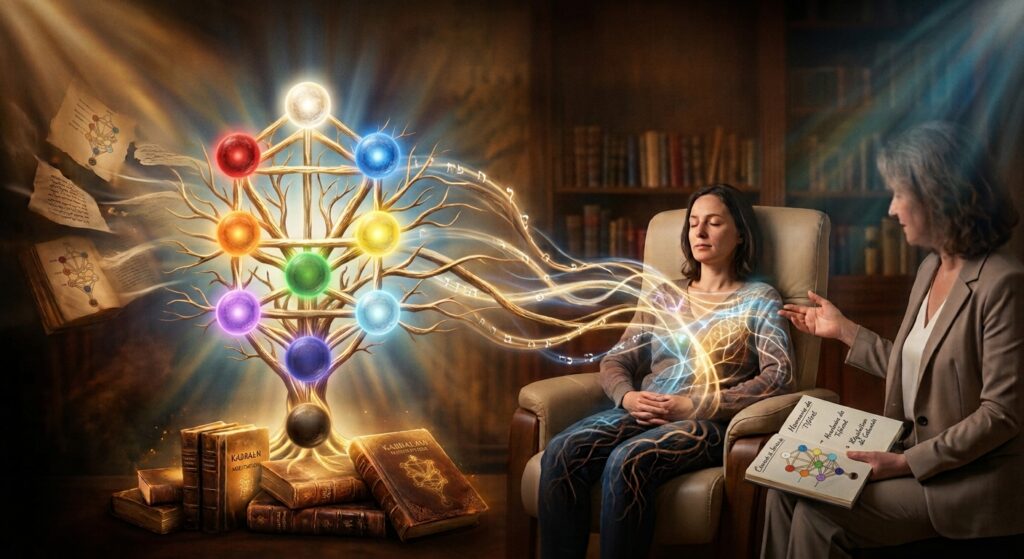
Sanford Drob discerns a deep correspondence between Yichudim practices and the processes of active imagination and metaphorization developed by Carl Jung and Sigmund Freud. The ten Sefirot form the Tree of Life, which can be viewed as an architectural mapping of the human psyche—the locus of crystallization of the power at the origin of the universe. Various Kabbalists propose (as I do in my workshops) using representations of the Sephirotic Tree as a pathway for meditation and imagery, wherein the seeker presents and unites with each sephirotic value/concept to balance kindness and severity, power and wonder, the masculine (Tiferet and its phallic continuation Yesod) and the feminine (Malkhut)… These meditative pathways are all the more « restorative » when conducted alongside various Kabbalistic explorations of core personal questions, the elaboration of desires, and personal fulfillment.
In this same perspective of therapeutic hierophany, it is worth mentioning Shevirat Ha-Kelim (שְׁבִירַת הַכֵּלִים, « breaking of the vessels »). This is a complex cosmological drama representing flows between the finite and the infinite. Kabbalists hold that during creation, the material vessels (finite), unable to contain the divine light (infinite), shattered, plunging the world into chaos—a chaos necessary for alterity to manifest, prefiguring other biblical dramas echoing this « instant » of eternity, such as the expulsion of Adam and Eve from Eden. This drama, continuously re-enacted systemically across the universe and within every creature, parallels ego destructuring and the flooding of consciousness by unintegrated archetypal material. Mystical processes and Tikkun practices aimed at repairing Shevirat Ha-Kelim directly apply to Jungian individuation, through which the subject gathers dissociated fragments of their psyche to construct a unified Self.
The Concept of Tikkun: From Cosmological Restoration to the Clinic of Healing Being (Tikkun Ha-Nefesh) and the World to Come (Tikkun Olam)
Beyond its role in Lurianic cosmology, the concept of Tikkun (תִּקּוּן, « repair » or « restoration ») constitutes the ethical and ontological pillar of the entire Kabbalistic endeavor, reflecting divine hope placed in humanity. In Lurianic theosophy, the cosmos was not created perfect; it was marked from its origin by this fracture and incompleteness necessary for human beings to exist freely. The fundamental role assigned to human beings is not passive resignation, but active participation in repairing and creating the world and oneself.
Tradition distinguishes two complementary dimensions of this restorative task:
- Tikkun Ha-Nefesh (תִּקּוּן הַנֶּפֶשׁ, « repair of the soul / of being »): Refers to self-transformation and individual realignment with the source of life, akin to psychological healing. Clinically, Tikkun Ha-Nefesh invites us to conceive therapy not merely as suppressing a biological or functional deficit, but as a process of dialectical integration—gathering dissociated, wounded, or repressed parts of the subject (sparks of consciousness / Nitzotzot) trapped in traumatic structures (Kelipot) to rebuild Self coherence.
- Tikkun Olam (תִּקּוּן עוֹלָם, « repair of the world »): Posits that healing the individual simultaneously generates the potential to repair their social environment, homeostasis, and ecosystemic features… Sanford Drob highlights that Tikkun provides an indispensable ethical impulse to clinical practice. Psychotherapy cannot be confined to conformist adaptation to a dysfunctional social order; it must grant the subject psychic resources to re-engage creatively and restoratively with the world.
From a contemporary clinical perspective, the Tikkun model prefigures and enriches approaches focused on post-traumatic resilience, Post-Traumatic Growth (PTG), and existential/humanistic therapies. Symptoms or traumatic events are no longer viewed as destructive fatalities, but as the « broken shell » from which a creative work of building and re-appropriating life meaning emerges—reminiscent of Viktor Frankl’s logotherapy, founded on the premise that searching for meaning is primary human motivation.
5. Comparative Perspectives: Parallels with Christian Mysticism
To deepen the heuristic value of this study, Kabbalistic mechanisms must be paralleled with contemplative approaches developed within Christian mysticism. These traditions share similar attentional and psychosomatic structures illuminating universal foundations of psychic regulation.
Hesychasm and the Jesus Prayer: Analogy with Somato-Psychic Regulation
Developed since the 4th century by the Desert Fathers and formalized in Orthodox tradition, Hesychasm (from Greek Hesychia, « silence » or « rest ») is a contemplative prayer method centered on continuous repetition, notably of the Jesus Prayer. Hesychast masters elaborated a physiology of prayer associating sacred phrasing with strict control of breath and heart rate.
Hesychasm shows remarkable convergence with Kavanah and the Niggun regarding physiological regulation, three-part breathing, and vowel chanting:
- Somato-psychic anchoring: The practitioner synchronizes inhalation with the start of the formula (« Lord Jesus Christ, Son of God ») and exhalation with the second part (« have mercy on me, a sinner »).
- Reduction of sympathovagal activation: Slow, rhythmic breathing induces heart rate variability (HRV) coherence and lowers neuromuscular tension, fostering deep mental calm (Hesychia).
- Guarding the heart: Attention is continually brought back to the center of the chest, preventing consciousness from scattering into cognitive ruminations (Logismoi).
Centering Prayer and Lectio Divina
In the 20th century, Western Christian tradition saw the emergence of Centering Prayer, developed by Trappist monks such as Thomas Keating, Basil Pennington, and Thomas Merton. Inspired by the medieval text The Cloud of Unknowing, this practice uses a « sacred word » as an anchor to let go of discursive intellectual activity. Whenever thoughts or emotions arise, the practitioner detaches by returning to the anchor word—a practice identical to Kabbalistic Divine Name techniques.
Parallelly, Lectio Divina (« divine reading ») constitutes a four-stage textual meditation method: Lectio (attentive reading), Meditatio (reflection and rumination), Oratio (emotional heart response), and Contemplatio (silent rest in the presence). This pathway mirrors Kabbalistic textual analysis phases, where intellectual study gradually yields to direct experience of meaning.
Apophatic vs. Cataphatic Theology in Clinical Practice
Mystical theology traditionally distinguishes two paths to the Sacred, matching two major psychotherapeutic paradigms:
- The Apophatic Path (Negative Theology): Proceeds by stripping away images, concepts, and words to experience divine emptiness. Clinically, this correlates with mindfulness (Open Monitoring), letting go, and psychoanalytic « evenly-suspended attention » practiced without memory or desire.
- The Cataphatic Path (Affirmative Theology): Abundantly uses symbols, guided imagery, stories, and metaphors to approach the Sacred. Clinically, this aligns with visualization, Ericksonians hypnosis, cognitive restructuring, and guided archetypal imagery.
|
Mystical Tradition |
Fundamental Practice |
Spiritual Mechanism |
Analogous Psychotherapeutic Model |
|---|---|---|---|
|
Jewish Kabbalah |
Tzeruf (צֵרוּף, « permutation ») & Gematria (גְמַטְרִיָּה, « calculation »). |
Deconstruction of fixed textual meaning. |
Lacanian metaphorization, free association, deconstruction, psychodrama. |
|
Jewish Kabbalah |
Niggun (נִגּוּן, « melody ») & Nekudat Ha-Tov (נְקֻדַּת הַטּוֹב, « point of goodness »). |
Release of sparks (Nitzotzot) from shells (Kelipot). |
Music therapy, cognitive restructuring, Rogerian alliance. |
|
Jewish Kabbalah |
Hitbodedut (הִתְבּוֹדְדוּת, « seclusion »). |
Free verbalization before Ein Sof (אֵין סוֹף, « Infinite »). |
Psychodynamic catharsis, Gestalt therapy, Psychodrama (empty chair). |
|
Jewish Kabbalah |
Yichudim (יִחוּדִים, « unifications ») & Sefirot (סְפִירוֹת, « emanations »). |
Restoration (Tikkun) of harmonic polarities. |
Analytical psychology (Jung), individuation, Shadow integration, IFS polarization. |
|
Christian Mysticism |
Hesychasm & Jesus Prayer. |
Anchoring consciousness in the heart via breath. |
Cardiac coherence, biofeedback, vagal regulation. |
|
Christian Mysticism |
Centering Prayer & Lectio Divina. |
Stripping away discursive thought (apophatic path). |
Mindfulness (MBSR/ACT), deactivation of ruminations. |
6. Proposals for Empirical Research and Clinical Workshop Design
To transpose these theoretical convergences into action research and clinical practice, readers are invited to contact the author. A study group could be formed in which the author proposes to transmit the primary Kabbalistic techniques discussed here while introducing rudiments of Biblical Hebrew. The group or individuals could then plan research and experimental modules within self-defined frameworks.
Below are three experimental workshop protocols to be refined and augmented by experts for implementation in university hospital centers or outpatient facilities. Patient language relations and Hebrew connection must also be conceptualized (including linguistic positioning for French Gematria):
Workshop A: Nominal Hermeneutics and Genosociogram (Transgenerational Clinic)
- Target Audience: Adults presenting symptomatic repetitions, impostor feelings, or identity blockages linked to unelaborated family traumas.
- Theoretical Framework: Anne Ancelin Schützenberger’s psychogenealogy combined with Kabbalistic nominal hermeneutics.
- Clinical Protocol: Guided elaboration of a three-generation genosociogram. Application of phonetic/semantic decomposition inspired by Tzeruf to ancestor and patient names to isolate cryptograms and reveal unconscious « project-meaning ». Concludes with symbolic writing to return transgenerational mandates to ancestors, enabling autonomous name ownership.
Workshop B: Music Therapy and Resilience (Niggun and Nekudat Ha-Tov Workshop)
- Target Audience: Patients suffering from anxious-depressive disorders, affective dysregulation, or PTSD.
- Theoretical Framework: Niggun chanting and Nekudat Ha-Tov exploration.
- Clinical Protocol: Somatic preparation combining gentle stretches and Hesychast-based cardiac coherence (5s inhalation + light visualization, 5s retention with light spreading, 5s exhalation of blue/peace). Group chanting of a traditional Niggun evolving from slow to dynamic tempo for emotional discharge and vagal stimulation. Followed by reflective writing to identify personal Nekudat Ha-Tov (a core resource maintained despite suffering). Ends with group verbal sharing to reinforce therapeutic alliance.
Workshop C: Textual Deconstruction and Cognitive Restructuring (Tzeruf Workshop)
- Target Audience: Patients with marked cognitive rigidity, OCD, or petrified schematic beliefs.
- Theoretical Framework: Tzeruf techniques and deconstruction principles.
- Clinical Protocol: Formulating dysfunctional beliefs on paper (e.g., « I must control everything to avoid rejection »). Guided linguistic deconstruction: word fragmentation, anagrams, letter permutations, and new semantic associations. Demonstrates language plasticity and automatic thought arbitrariness. Concludes with co-constructing flexible statements anchored by Kavanah.
Systematic investigation of convergences between Kabbalah, Christian mysticism, and contemporary psychotherapies demonstrates universal therapeutic structures within contemplative traditions. Methods like Gematria, Tzeruf, Niggun, or Hitbodedut constitute semiotic, somatic, and cognitive tools of great potential efficacy.
These practices anticipated major developments in human sciences, Lacanian psychoanalysis, Jungian analytical psychology, Derridean post-structuralism, and integrative behavioral therapies. Implementing experimental workshops opens fertile research avenues for medicine and clinical psychology, offering care pathways that reconcile empirical rigor with existential depth.
Focus on Dr. Sanford L. Drob :
Sanford L. Drob is an American clinical psychologist, forensic psychologist, philosopher, author, and painter. He is particularly recognized for his work at the intersection of Carl Gustav Jung’s analytical psychology, contemporary philosophy, and Jewish mysticism (Kabbalah).
Dr. Drob developed a philosophical-theological approach he calls the « New Kabbalah » (The New Kabbalah). Through his writings, he reinterprets traditional mystical symbols using deconstruction and modern psychology.
- Website: https://sanforddrob.com/
- Education: Holds a double doctorate—one in Philosophy from Boston University and another in Clinical Psychology from Long Island University.
- Academic & Clinical Roles: Professor Emeritus in the Clinical Psychology Doctoral Program at Fielding Graduate University; faculty member at the C.G. Jung Institute of New York. For many years, he directed psychological testing and served as Senior Forensic Psychologist at Manhattan’s famous Bellevue Hospital. He maintains a private practice in New York.
Footnotes :
- Kabbalah (קַבָּלָה): Literally « reception » or « tradition ». Refers to the esoteric and mystical tradition of Judaism, aiming to explore the nature of the Divine, the creation of the cosmos, and the human soul.
- Sigmund Freud (1856–1939): Founder of psychoanalysis. Several scholars (such as David Bakan) have highlighted structural analogies between Kabbalistic exegesis and Freudian dream interpretation.
- Carl Gustav Jung (1875–1961): Founder of analytical psychology, who explicitly referenced Gnosticism and Jewish mysticism in formulating archetypes and the collective unconscious.
- Integration of the Shadow: Jungian concept designating the process of recognizing and integrating repressed or unacknowledged parts of the psyche into consciousness.
- Individuation: Jungian process of psychological differentiation through which an individual develops a unique, integrated Self.
- Sanford L. Drob: Clinical psychologist and philosopher whose books (e.g., Kabbalistic Metaphors: Jewish Mysticism and Modern Psychology) systematically bridge Kabbalah and modern psychotherapy.
- The New Kabbalah: Philosophical and psychological framework formulated by Sanford Drob that interprets Kabbalistic symbols through contemporary philosophy (deconstruction) and psychoanalysis.
- Semiotics of the Unconscious: The study of signs, symbols, and linguistic structures through which the unconscious expresses itself.
- Mindfulness: The practice of intentional, non-judgmental awareness of present-moment experience, widely integrated into cognitive-behavioral therapies (e.g., MBSR, ACT).
- Activation of Archetypes: Stimulating latent universal psychological patterns in the collective unconscious using symbols, sounds, or visual imagery.
- Marcel Jousse (1886–1961): French anthropologist and Jesuit priest, pioneer of the Anthropology of Gesture, who studied oral traditions, rhythm, and bodily expression in human memory and language.
- Article Reference: Bruno Jacopé-Fouchereau, « Le chant des voyelles hébraïques… » available online at: https://lun-deux.fr/le-chant-des-voyelles-hebraiques/
- 22 Hebrew Consonants: In Kabbalah, the 22 letters of the Aleph-Bet are considered the primordial building blocks of creation (Sefer Yetzirah).
- Post-Structuralism: Philosophical movement (including Derrida, Barthes, Foucault) questioning fixed meanings and highlighting the fluid, open nature of textual signifiers.
- Gematria (גְמַטְרִיָּה): Hermeneutic method assigning numerical values to Hebrew letters, establishing connections between words of equal value.
- Tzeruf (צֵרוּף): Kabbalistic technique of permuting and combining letters and vowels to unlock deeper layers of meaning and alter states of consciousness.
- Notarikon (נוֹטָרִיקוֹן): Exegetical method forming acronyms from initial/final letters of words or expanding single words into full phrases.
- Triliteral Root Analysis: Etymological examination of three-letter roots in Hebrew, revealing underlying semantic fields and spiritual connections.
- Semantic De-automatization: Psychological phenomenon of breaking habitual associations and mental routines attached to words and concepts.
- Free Association: Fundamental technique in psychoanalysis where the patient speaks freely without censorship, revealing unconscious material.
- Jacques Lacan (1901–1981): French psychoanalyst who famously stated that « the unconscious is structured like a language. »
- Metaphor and Metonymy: The two primary linguistic axes identified by Lacan corresponding respectively to condensation and displacement in Freud’s dream-work.
- Condensation and Displacement: Verdichtung (condensing multiple ideas into one) and Verschiebung (shifting emotional accent from one element to another), defined by Freud in The Interpretation of Dreams.
- Semantic Flexibility: The ability to alter perspectives, restructure meanings, and create new interpretations of personal experiences and symptoms.
- Jacques Derrida (1930–2004): French philosopher and father of Deconstruction, emphasizing textual indeterminacy and endless deferral of meaning (différance).
- Isaac Luria (1534–1572): Known as the ARI, central figure of Safed Kabbalah who introduced the concepts of Tzimtzum, Shevirat Ha-Kelim, and Tikkun.
- Tzimtzum (צִמְצוּם): Divine contraction or self-withdrawal creating a primordial space (Tehiru) allowing creation and alterity to exist.
- Infinite Container: Therapeutic concept where the therapist creates a non-judgmental, spacious environment holding the patient’s complex emotional material.
- Hermeneutic Process: An ongoing, open-ended interpretative dialogue that continually unfolds new layers of personal truth.
- Shem (שֵׁם): Hebrew word for « Name », sharing roots with listening (Sh’ma) and spiritual identity.
- Sefer Yetzirah (סֵפֶר יְצִירָה): « Book of Formation », one of the earliest texts of Jewish mysticism exploring creation through numbers (Sefirot) and letters.
- Rabbinic Name Healing: Traditional practice of analyzing, modifying, or adding a name (e.g., Chaim meaning « life ») for an ill person to change their spiritual trajectory.
- Anne Ancelin Schützenberger (1919–2018): French psychologist and pioneer of psychogenealogy, author of The Ancestor Syndrome.
- Invisible Family Loyalty: Concept formulated by Ivan Boszormenyi-Nagy describing unconscious commitments individuals hold toward family rules and history.
- Project-Meaning (Projet-Sens): Concept from clinical psychology/psychogenealogy describing the conscious and unconscious intentions projected onto a child by parents before and around birth.